

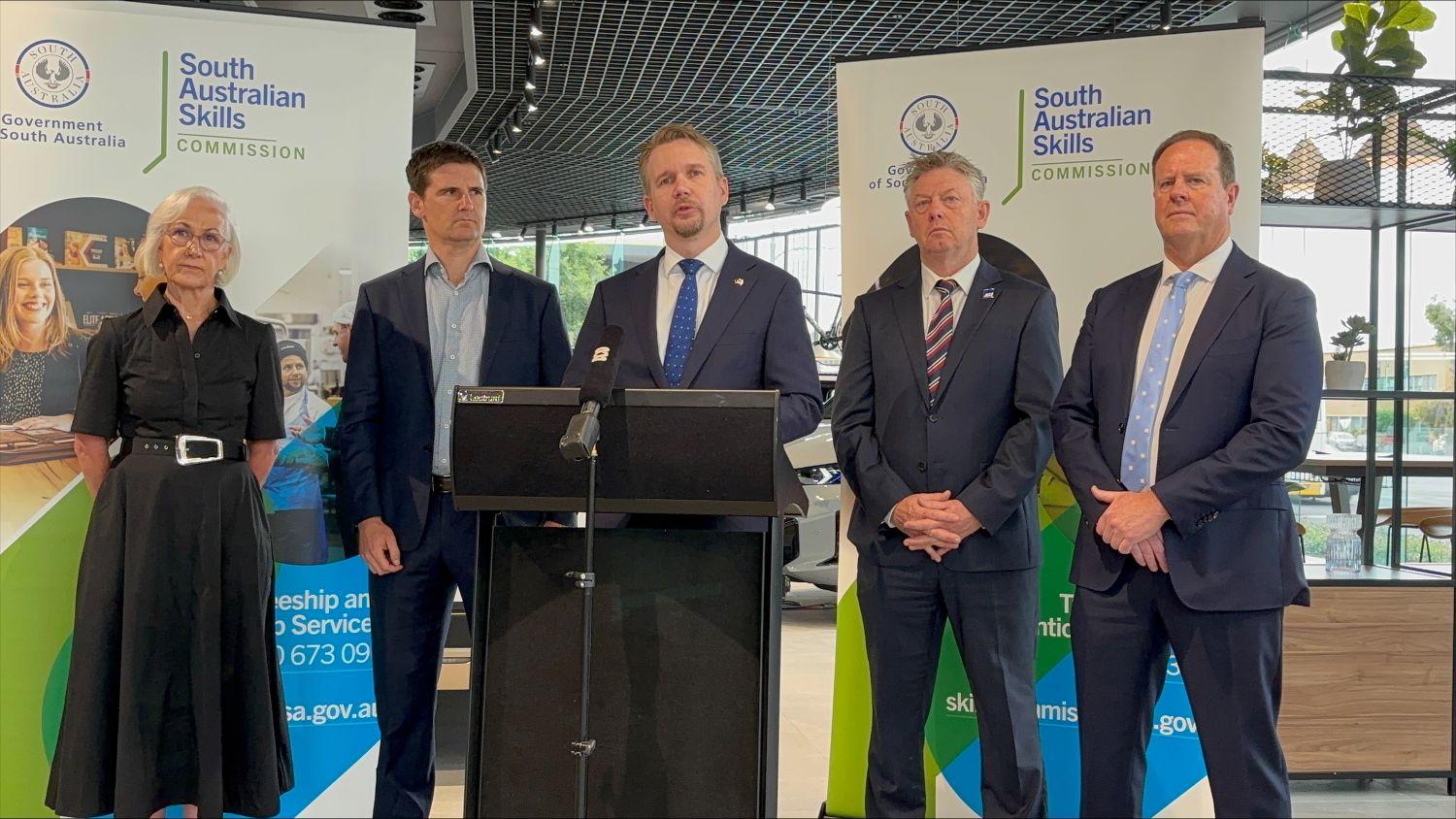
Commissioner Cameron Baker, Chair of the South Australian Skills Commission announcing enforcement of trade apprenticeships with industry partners.
Left to Right: Merrill Gratton, Co-President, South Australian Hair and Beauty Association; Will Frogley, CEO, Master Builders SA; Commissioner Cameron Baker; Darrell Jacobs, CEO, Motor Trade Association SA/NT; Andrew Clarke, CEO, Master Plumbers Association of South Australia.
Enforcement of trade apprenticeships
The South Australian Skills Commission (the Commission), the state’s independent regulator responsible for overseeing apprenticeships and traineeships, today affirmed its renewed commitment to ensuring the integrity of trade training across the state.
Based on numbers submitted by Registered Training Organisations (RTOs) to the National Centre for Vocational Education Research (NCVER), the Commission understands that in 2024, over 4,000 qualifications declared as trades in South Australia were commenced institutionally, outside of formal apprenticeship arrangements.
Institutional-based trade training does not provide the safeguards offered under a formal training contract. Individuals in trades are exposed to high-risk work environments, requiring technical training and higher levels of supervision. The formal apprenticeship model ensures apprentices are safe on the job, are paid for their work, have a structured training plan, and are appropriately supervised on the worksite by an employer registered with the Commission.
The Commission has applied an amnesty until 30 January 2026 for new institutional enrolments in South Australia. Any Registered Training Organisation (RTO) that issues a new enrolment from 31 January 2026, that is:
• in a qualification that has been declared a trade in accordance with the Act; and
• delivered in South Australia outside of a training contract
will be subject to a $315 expiation fee per case and where applicable, penalties of up to $5,000.
This action will ensure individuals enter the workforce from the commencement of their training through the proven ‘earn and learn’ apprenticeship pathway. From 31 January 2026, affected learners will be able to complete their qualification and apply to the Commission for a skills assessment under the Occupational Recognition Service. Where they meet the required standards, the Commission will issue an Occupational Certificate, which is recognised by industry.
The Commission is working closely with industry partners and RTOs to enforce strict compliance and ensure learners are certified and protected through recognised apprenticeship pathways.
Posted 10/12/2025