

We’re here to support you throughout your apprenticeship or traineeship, because we understand the many benefits it offers, like earning while you learn, building real-world skills, gaining a qualification and setting yourself up for a strong career.
We can start by reassuring you that disagreements are a part of life. Addressing them early, and with guidance, can greatly reduce their impact.
If you have questions or concerns, your Apprentice Connect Australia Provider (ACAP) is a great first point of contact. They can help explain how things work in your specific situation.
Still have questions or need additional help?
Explore the Steps for Resolution below to see how we can assist —or contact us directly. Reaching out early can make resolution faster and easier to navigate.
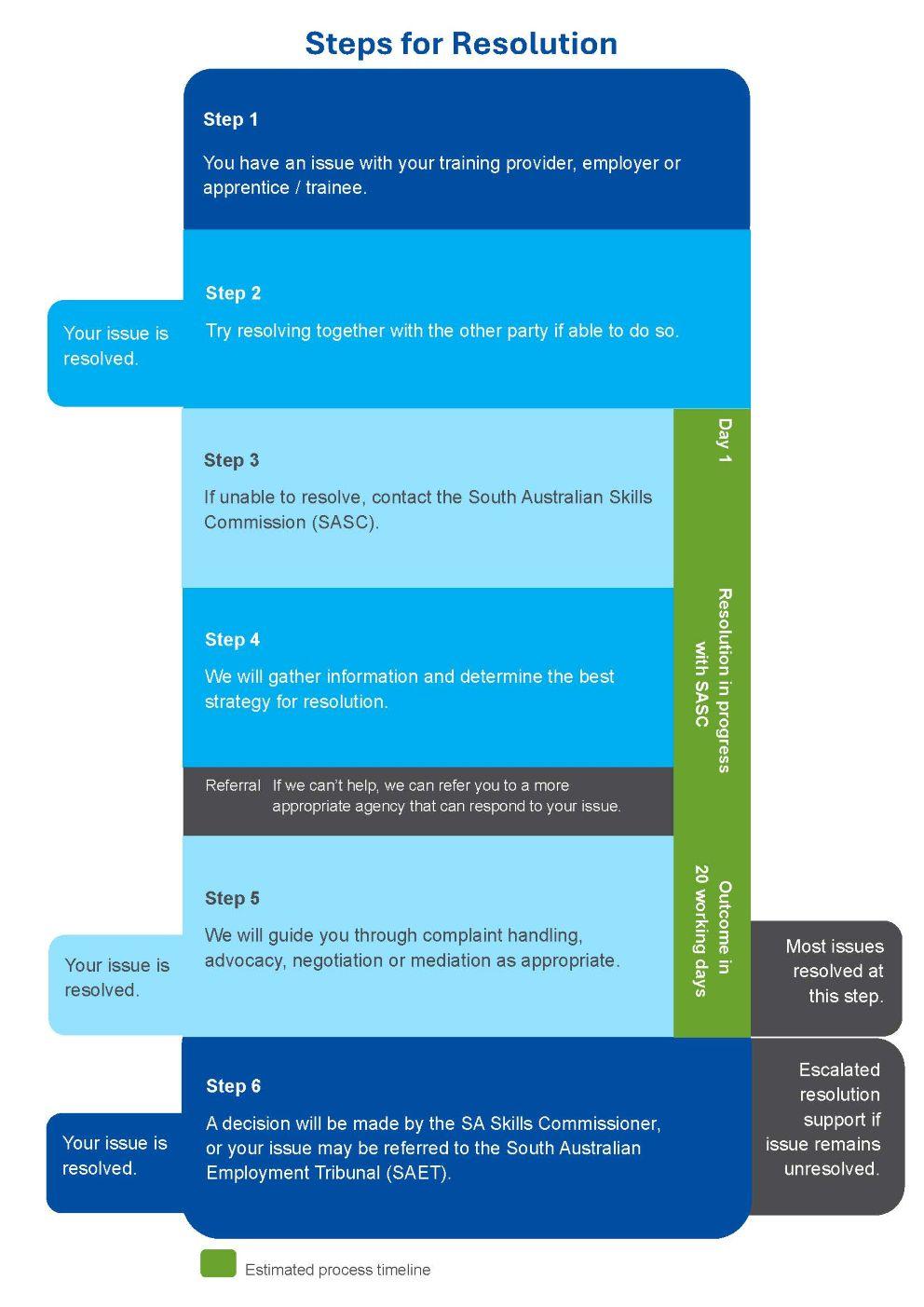
We’re here to help you resolve issues and stay on track.
Try starting with an informal conversation with your employer. Problems can usually be resolved quickly if you raise your concerns early.
Remember to keep documented records of your conversations.
The types of issues that can arise
For example, allegations of criminal conduct and State or federal industrial relations issues sit outside of the Commissions jurisdiction. We will always guide you to the appropriate authority or service for assistance.
When Jordan tried to transfer her apprenticeship to a new employer closer to home, things didn’t go as planned. Between fees, delays, and mounting stress, she nearly gave it all up despite being three years in.
The right guidance from us helped her turn things around.
It’s not always easy to speak up when you’re in disagreement with someone and things get tense. We offer neutral support to help ease the way forward and resolve issues quickly.
If something’s not right, you can let us know. We’re here to listen, support, and help find the right outcome, notifying you every step of the way.
We’re here to speak up for you – whether it’s sorting out training contract issues, handling complaints, or supporting you through disputes before the SAET.
Prefer to talk things through informally? Direct Negotiation keeps you in control, with guided support and a clear timeframe – no pressure, just a chance to resolve things early.
We are here to help. Reach out by phone or email to see how we can help resolve your issue with training or an apprenticeship or traineeship.
If something isn't right, you can lodge a complaint through our online disputes portal.
Our dedicated case managers will assist with your issue and help you navigate towards a solution.
You’re encouraged to contact us first when a dispute arises. Our aim is to resolve as many matters as possible using our own processes and powers. Ideally, issues are resolved through negotiation, mediation or a Commissioner decision before any formal conciliation or tribunal action is required.
When SAET does become involved, it has a range of powers under Section 65 of the South Australian Skills Act 2008 (the Act). Many of these powers are shared with the Commission.
However, SAET can also make broader legal decisions. For example:
It has limitations too. The SAET does not have jurisdiction to make a formal decision and order that an employer pay a transfer fee. This issue should be directed to the Commission.
Dispute form(s) can be obtained via the SAET Forms page.
Applications must be lodged either during the term of the training contract or within six months of its completion, expiry, or termination.
The SAET will notify you and your employer of the date, time, and location of the conciliation conference. This usually takes place 14 calendar days after dispute application is lodged.
The person you named in your application (the respondent) will also receive a copy of the application and any supporting documents. In disputes cases, they will be asked to send a written response to SAET before the conciliation conference, explaining their side of the issue.
When does mediation take place?
If you’ve been suspended, we will aim to complete mediation within three days from dispute lodgement and no later than seven-working days.
Learn more about our mediation process.
What happens if mediation doesn’t resolve the issue?
If the matter can’t be resolved by mediation, your employer must refer the matter to the SAET for consideration. This must happen as soon as reasonably practicable after the mediation concludes (within three working days).
Your employer must notify you if they believe there are reasonable grounds to suspend your training contract for wilful and serious misconduct, under Section 64 of the South Australian Skills Act 2008 (the Act).
Under the Fair Work Regulations 2009 - serious misconduct refers to an employee deliberately behaving in a way that is inconsistent with continuing their employment.
Examples include:
The suspension may begin immediately but can last no longer than seven working days.
It is your employer’s responsibility to:
• refer the matter to the Commission for mediation
• notify the SAET that the matter has been referred
• notify the apprentice/trainee that the matter has been referred
• comply with any reasonable requirement of the Commission in relation to the mediation.
Important: It is not the Commission’s role to determine if an employer had reasonable grounds to suspend an apprentice or trainee. Our role is to ensure you’re aware of your obligations under the Act.
You can find out more in the relevant Skills Standards
We’re here to help you resolve issues and stay on track with your apprenticeship or traineeship.